
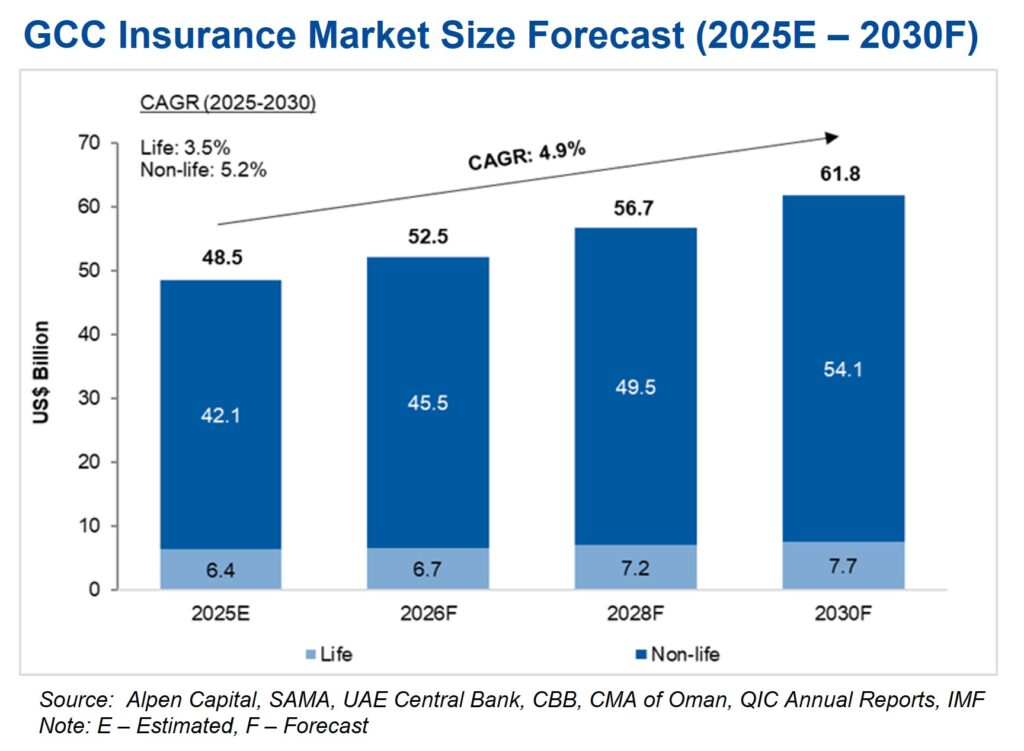
According to Alpen Capital, the GCC insurance market is projected to grow at an annualized rate of 4.9% from US$ 48.5 billion in 2025 to US$ 61.8 billion in 2030, subject to prevailing economic and geopolitical uncertainties. Sustained increase in population, recovery in economic activity, expansion of mandatory insurance lines and higher regulatory oversight are among the leading factors that will facilitate growth in the sector. The life insurance GWP is projected to grow at a CAGR of 3.5% from US$ 6.4 billion in 2025 to US$ 7.7 billion in 2030. Meanwhile, the non-life insurance segment is projected to grow at a CAGR of 5.2% to reach US$ 54.1 billion in 2030 from US$ 42.1 billion in 2025. This growth is expected to be led by increasing urbanization rates and a strong pipeline of large-scale infrastructure development projects across the GCC. Insurance density is expected to increase from US$ 775.3 in 2025 to US$ 907.5 by 2030, while insurance penetration is anticipated to change marginally during the same period.
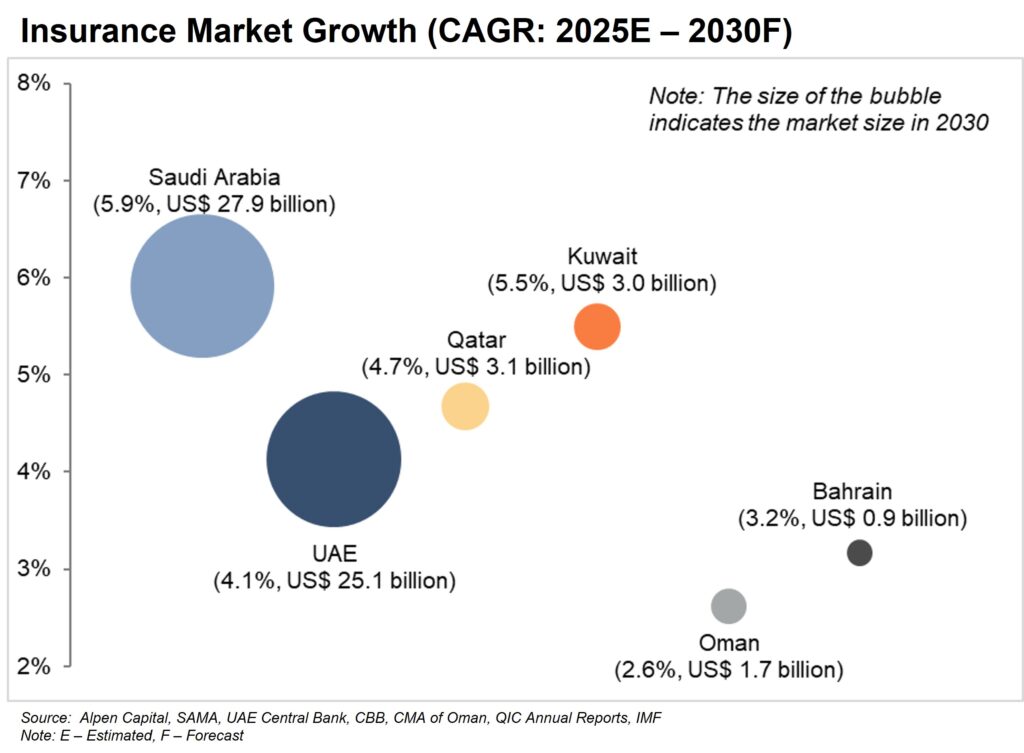
With respect to the individual GCC countries, Saudi Arabia is expected to retain its position as the largest insurance market in the region and witness the highest growth rate, with a CAGR of 5.9% between 2025 and 2030. Kuwait is projected to follow Saudi Arabia with a CAGR of 5.5%, while the UAE insurance market is anticipated to grow at a CAGR of 4.1%.
The GCC economies are expected to remain resilient despite the challenging external environment and geopolitical concerns. The sizable infrastructure investment programs, progressive reforms, strong emphasis towards economic diversification and private sector participation, are expected to bode well for the region’s insurance industry. Furthermore, a growing population, largely comprising of young and working-class professionals, together with high proportion of expatriates, continue to be a major driver for the industry. The continued expansion of mandatory business lines will also further boost the demand for insurance products driving overall growth.
However, the sector has been put under pressure due to lower revenues because of sharp correction in oil prices, burden on fiscal balances, and volatility in travel demand amid the current geopolitical scenario. Softer investment returns, rising reinsurance costs, high operational expenses, and increasing claims are also weighing on margins and overall profitability. Insurance penetration is projected to remain low during the forecast period due to low awareness and a relatively underdeveloped life insurance market.
The report notes that changing consumer behavior and adoption of digital technologies has compelled the regional insurance companies to create a new ecosystem in accordance with digitalization preferences. At the same time, regulators across the GCC have introduced reforms as part of their broader FinTech strategy, including the adoption of InsurTech. Increasing digitalization across businesses, financial institutions, and critical infrastructure sectors is accelerating the demand for cyber insurance solutions as organizations seek protection against evolving threats and operational disruptions. The region is also experiencing a heightened demand for specialty insurance products such as war-risk, marine, political risk, and cyber insurance on the back of rising geopolitical uncertainties and global risk dynamics.
Going forward, the GCC insurance industry is likely to move towards strategic expansion initiatives, with major insurers pursuing acquisitions of smaller companies, along with digital-first operators and aggregators. This is expected to enhance market positioning and operational efficiency, while fostering innovation and the introduction of new offerings.