
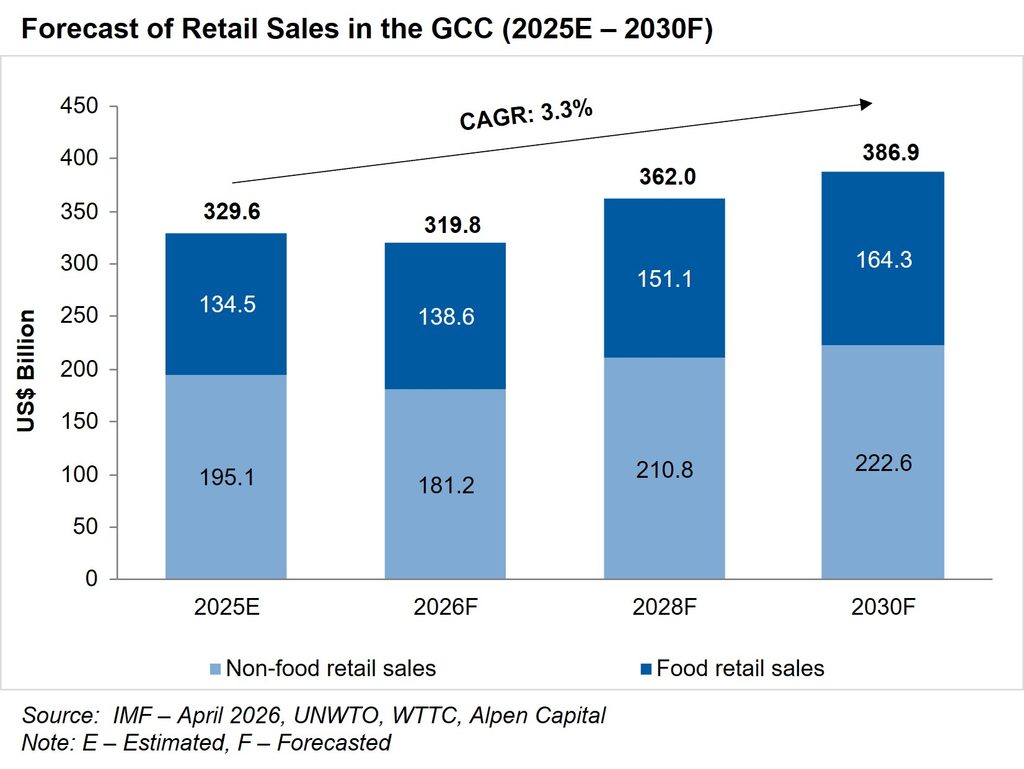
According to Alpen Capital, retail sales in the GCC are projected to grow from US$ 329.6 billion in 2025 to US$ 386.9 billion by 2030 at a CAGR of 3.3%. This growth is expected to be driven by stable macroeconomic fundamentals, an expanding population base, rising tourism and improving disposable incomes. Non-food retail sales are anticipated to grow at a CAGR of 2.7%, while food retail sales are expected to rise at a pace of 4.1% CAGR between 2025 and 2030 across the GCC.
While retail sales this year have experienced a decline amid geopolitical uncertainties and supply-chain vulnerabilities, the sector is expected to maintain steady growth going forward. This outlook is supported by positive macroeconomic indicators, government initiatives and anticipated recovery in consumer spending.
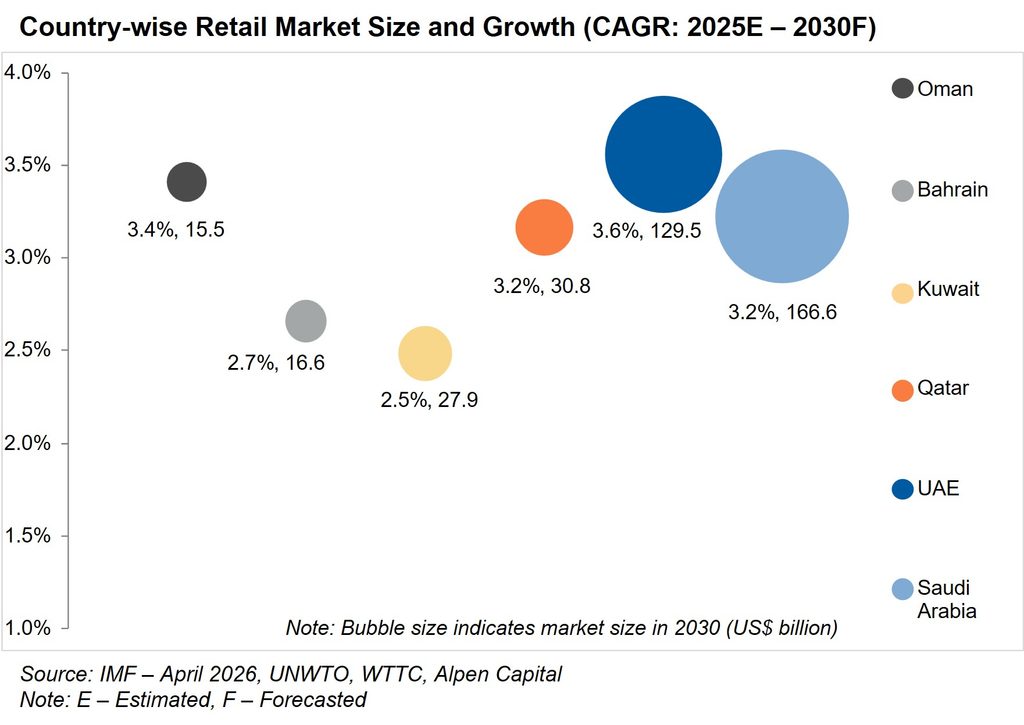
Retail sales in the individual GCC nations are projected to grow in the range of 2.5% and 3.6% CAGR between 2025 and 2030. The region’s largest retail markets, Saudi Arabia and the UAE are expected to grow at CAGRs of 3.2% and 3.6% to reach US$ 166.6 billion and US$ 129.5 billion, respectively, by 2030. This growth will be underpinned by their expanding population bases and well-developed infrastructure, which make them attractive shopping destinations. Qatar and Kuwait follow next in terms of market size and are forecasted to witness CAGRs of 3.2% and 2.5%, respectively, between 2025 and 2030.
Duty free sales at the GCC airports of Dubai, Abu Dhabi, Qatar and Bahrain are expected to reach US$ 4.3 billion by 2030, growing at a CAGR of 4.8% since 2025. This growth can be attributed to the anticipated rise in passenger traffic, largely driven by government initiatives to promote tourism and capacity expansion plans.
As for the gross leasable area (GLA), at 80% completion of projected additions, 4.6 million sq. m. of retail space is likely to come up in the GCC between 2025 and 2030, taking the total organised retail GLA to 27.0 million sq. m. This is a modest growth scenario, wherein organized retail GLA is anticipated to grow at a CAGR of 3.8% during the period.
As per the report, a growing population, coupled with a high concentration of expatriates and HNWIs, remains one of the primary factors driving growth of the GCC’s retail industry. Despite the current geopolitical environment, economic activity is expected to remain resilient, supported by higher oil prices and robust non-hydrocarbon growth. Meanwhile, expanding infrastructure development and the GCC’s growing prominence as a hub for global business, entertainment, and sporting events are expected to support retail activity. Religious tourism also continues to account for a significant share of tourist arrivals, further supporting retail growth. In addition, the rapid proliferation of e-commerce and quick-commerce platforms is expected to generate incremental revenues for operators and strengthen the broader retail ecosystem by expanding digital reach, improving customer convenience, and creating new avenues for growth.
However, the GCC’s exposure to global macroeconomic headwinds, owing to its high dependence on hydrocarbon revenues and lingering geopolitical concerns, could weigh on consumer sentiment and place the retail industry under pressure. The region’s heavy reliance on food imports also exposes it to external supply-side disruptions, which could exacerbate inflationary pressures and reduce consumers’ purchasing power. Moreover, the growing presence of international brands and rapid expansion of e-commerce platforms have intensified competition within the industry. Retailers are responding with aggressive promotional and discounting strategies to gain market share, which is supporting top-line growth but placing pressure on profit margins.
The report also highlights several trends that are shaping the retail landscape of the GCC. The increasing move towards omni-channel business models to meet consumer expectations is enabling retailers to leverage stores as fulfilment hubs, offer services such as buy online, pick up in-store, BNPL, and same-day delivery, among others. Concurrently, pop-up stores are becoming a prominent retail format as brands seek flexible ways to enter new markets, test concepts, and engage consumers. Retailers are also moving beyond basic digitalisation towards the use of AI for advanced analytics and automated decision-making across functions. Lastly, the growing demand for healthy food items is prompting retailers to expand their assortment of organic, fresh, and minimally processed products.
As the industry continues to mature, these emerging trends and evolving consumer preferences are likely to reshape the market dynamics. Retailers are adopting innovative business models and leveraging digitalization to unlock new value-creation opportunities. While traditional retailers pursue organic expansion strategies, industry consolidation is expected to accelerate as companies seek to improve profitability, achieve greater scale, and strengthen their market share.