
Dubai, 24th November 2026: Alpen Capital announced the publication of its GCC Aviation Industry Report which provides a perspective on the GCC aviation sector by presenting the current industry status, key market dynamics, and scope for future growth. It examines the key sub-segments of the aviation market by identifying fundamental growth drivers, significant challenges, and recent trends. The report also profiles each of the six GCC nations as well as the region’s major aviation players.
“The GCC has established itself as a global aviation hub, capitalising on its strategic location and robust infrastructure. While the region’s aviation sector continues to be led by full-service carriers, low-cost carriers have gained significant market share. The region’s MRO market has also expanded over the years, owing to increasing connectivity and a heightened focus on capacity expansion and technology integration. However, recent geopolitical tensions have disrupted flight paths, as well as cargo and passenger operations, resulting in higher costs and reduced load factors for airlines and airports. We expect these challenges to be offset by economic recovery, favourable demographics, ambitious diversification agendas and continued investment in aviation infrastructure, supporting the sector’s growth momentum,” says Lakshmanan T.M., Chief Executive Officer, Alpen Capital
“We see significant growth opportunities emerging across the aviation industry, driven by advances in air mobility, an increased focus on sustainability, and continued fleet expansion. For GCC carriers, enhancing customer experience and developing strategic partnerships will remain important to maintain healthy margins over the long term. We also expect continued investment in mega-hubs to expand passenger capacity and strengthen cargo-handling capabilities. Meanwhile, M&A activity, which has picked up across the region in recent years, is expected to focus on cargo and logistics integration, airport infrastructure modernisation, MRO facilities, sustainable fuel and digital transformation initiatives,” says Rajan Gupta, Managing Director, Alpen Capital
GCC Aviation Industry Outlook
The GCC aviation industry is expected to witness significant growth over the medium to long term, largely driven by infrastructure investment by the government, rising participation from the private sector, higher demand from the travel & tourism industry and technological advancements. State-led infrastructure plans will support the expansion of full-service carriers (FSCs) and low-cost carriers (LCCs), while further augmenting the air cargo and logistics market. Ancillary revenues will also play an important role in improving margins in a competitive market. Further, the maintenance, repair and overhaul (MRO) sector is expected to support the long-term growth of the aviation industry by enabling access to local maintenance capabilities while strengthening regional hubs through investment, expertise, and strategic partnerships. Additionally, the industry is expected to adopt greener practices and invest in sustainable aviation fuel (SAF), electric ground equipment, and carbon reduction initiatives to meet global environmental standards. However, geopolitical tensions could disrupt optimisation of regional aviation strategies and raise operating costs for airlines in the short term.
Commercial Airlines Sector
As of 2025, the region had a commercial fleet of around 1,556 aircraft with the UAE and Saudi Arabia together constituting 71.0% of the total fleet size. UAE-based airlines had the highest fleet size of 624 aircraft, followed by Saudi Arabia with 483 and Qatar with 275. Government-owned FSCs accounted for approximately 62% of the region’s total fleet size as of 2025. Notably, Emirates holds the largest share of the fleet in the GCC at 30.2% of all FSCs. Currently, the six largest FSCs in the region (Emirates, Qatar Airways, Etihad Airways, Saudia, Gulf Air and Oman Air) have a combined order book of 486 aircraft to be delivered by the end of 2029. Of the total, Emirates has the largest order book with a 41.2% share, while Qatar Airways and Etihad Airways account for 23.0% and 20.6%, respectively.
At the same time, LCCs, which are budget or discount airlines, have garnered significant traction among passengers in recent years. Although Flydubai has the largest share of the fleet in the GCC (32.3% of all LCCs), Air Arabia, with a relatively smaller fleet, serves the highest number of destinations amongst its peers. Collectively, the four largest LCCs (Air Arabia, Flydubai, Flynas and Flyadeal) have a combined order book of 295 aircraft to be delivered by the end of 2029. Of the total, Air Arabia has the largest order book with a 38.6% share, slightly above Flydubai at 38.3%.
Passenger Traffic and Revenue
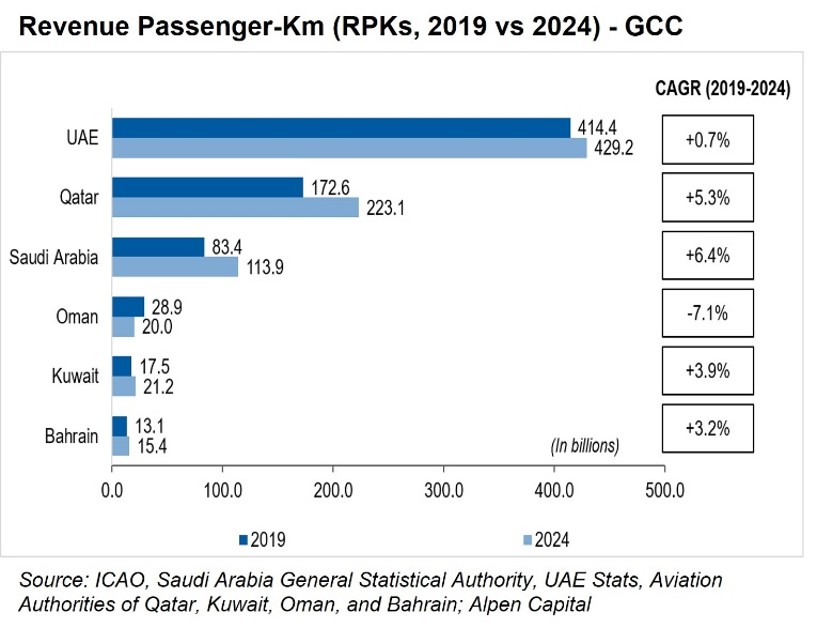
The passenger traffic of GCC airlines grew from 318.1 million passengers in 2019 to 373.0 million passengers in 2024 at a CAGR of 3.2%. The UAE and Saudi Arabia together constituted over 75.0% (276.4 million passengers) of the total air passenger traffic in the GCC as of 2024, up from 72.6% in 2019. Furthermore, in 2024, the region accounted for 3.9% of total global air passenger traffic. GCC passenger traffic further increased by 5.2% to 392.5 million in 2025.
In terms of Revenue Passenger-Km (RPKs), the GCC recorded a growth of 2.4% CAGR between 2019 and 2024 to reach 822.7 billion RPKs, surpassing the pre-pandemic levels. Saudi Arabia recorded the highest growth in RPKs (6.4% CAGR) over the five-year period, followed by Qatar (5.3% CAGR). However, the UAE remains the top market in the GCC in terms of RPK at 429.2 billion.
Air Cargo Sector
Freight tonne-km (FTKs) in the GCC grew to 34.0 billion FTKs in 2024 from 29.8 billion FTKs in 2019. The Hamad International Airport and Dubai International Airport collectively accounted for around 65% of the Middle East air cargo volume with ~2.6 million metric tonnes and ~2.2 million metric tonnes, respectively. Compared to select developed and emerging nations, the GCC ranks third behind the US and China, handling more cargo than Germany, Japan, the UK, and India.
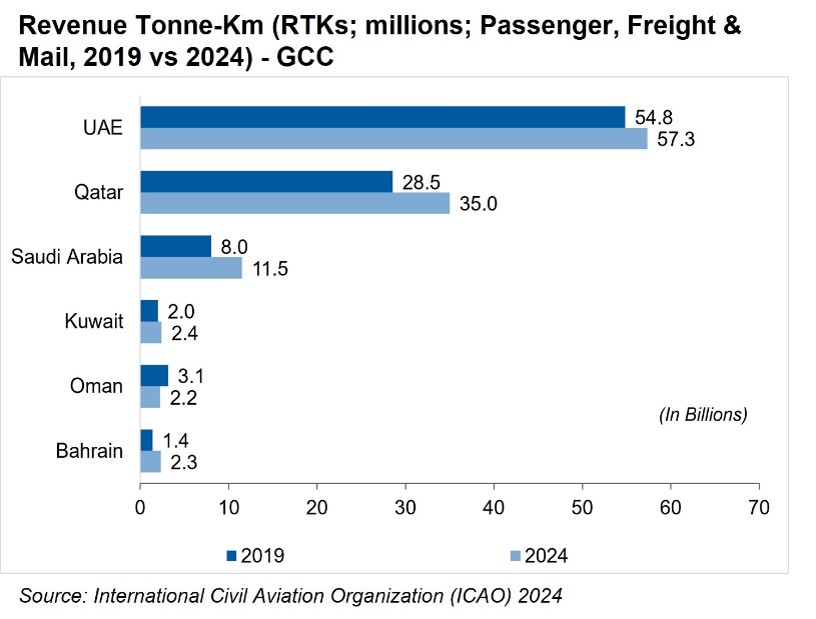
Meanwhile, revenue tonne-km (RTKs) in the Gulf states increased from 100.1 billion RTKs in 2019 to 110.7 billion RTKs in 2024, recording a CAGR of 2.0%. Within the region, the UAE accounted for 51.8% share with 57.3 billion RTKs as of 2024, substantially ahead of Qatar (35.0 billion RTKs) and Saudi Arabia (11.5 billion RTKs).
Maintenance, Repair and Overhaul (MRO) Segment
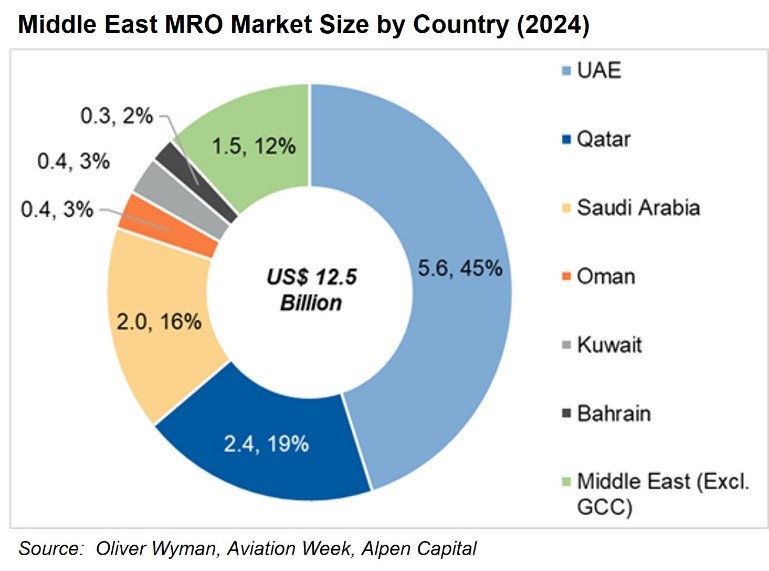
The Middle East MRO segment has grown at a CAGR of 6.8% between 2019 and 2024 to reach US$ 12.5 billion. In 2025, it further expanded to US$ 16.2 billion, representing a 29.6% y-o-y increase, driven primarily by the engine segment, which grew by 34.1% y-o-y to reach US$ 11.4 billion.
Notably, the UAE continues to lead the Middle East MRO market with an estimated 45% share (US$ 5.6 billion), while Qatar and Saudi Arabia account for considerably smaller shares of approximately 19% (US$ 2.4 billion) and 16% (US$ 2.0 billion), respectively. Collectively, the GCC nations are estimated to account for approximately 88% (US$ 11.0 billion) of the total Middle East MRO market as of 2024.
Growth Drivers, Challenges and Trends
Alpen Capital’s report also highlights several factors supporting the growth of the GCC aviation industry. The region’s strategic location continues to facilitate extensive air travel, supporting global tourism and business connectivity. Tourism remains a key driver, with international tourist arrivals in the GCC expected to grow at a CAGR of 4.0% between 2025 and 2030, reaching approximately 95.2 million. Other factors, including population growth, rising per capita income, and a high concentration of HNWIs, are expected to support long-term demand for aviation services. Additionally, ongoing liberalisation efforts and relaxed foreign ownership regulations continue to strengthen investor confidence and support capacity expansion across the sector.
On the other hand, although the GCC countries are not directly involved in the conflict, their aviation systems remain vulnerable to neighbouring airspace restrictions. Geopolitical events have created market volatility, compounding pressure on the operational stability of GCC airlines, while escalating fuel costs add further financial strain. In addition, the projected narrowing of the GCC’s fiscal surplus in 2026 may lead to scaling back of infrastructure investments, potentially slowing expansion plans. The industry is also witnessing intensified competition among regional carriers and concerns regarding overcapacity, due to new market entrants, increasing fleet sizes, and aggressive network expansion strategies by legacy airlines. Furthermore, the industry continues to face a shortage of skilled professionals, particularly pilots and technical engineers, amid rapid fleet expansion and rising air traffic volumes.
The report further states that sustainability is emerging as a prominent trend as the industry aligns with global aviation decarbonisation goals, with the GCC playing a central role in achieving net-zero carbon emissions by 2050. Codeshare agreements are becoming an important strategy for GCC-based airlines to expand network reach, improve operational efficiencies, enhance passenger connectivity, and remain competitive in an expanding market. Public-private partnerships (PPPs) are also on the rise, especially in Saudi Arabia, to develop and modernise airport infrastructure. Furthermore, stakeholders across the aviation value chain are accelerating the adoption of technology and digitisation to drive innovation, improve efficiency, and strengthen their market position.
As the GCC aviation industry enters a pivotal phase of expansion, growth is likely to be driven by investments across key segments such as infrastructure, manufacturing, MRO services, technology & digitisation, and training institutions. While the geopolitical crisis continues to impact the medium-term outlook, continued expansion of the aviation industry will largely depend on the duration and intensity of the conflict and the confidence of international passengers.
Transaction Announcement
Please click here to access Alpen Capital’s latest report on GCC Retail Industry Report 2026.